创建型
单例
单例模式分为两种,一种为饿汉式,一种为懒汉式,
饿汉式采用直接实例化 Singleton 的方式,但这样如果在不使用的情况下会消耗资源
懒汉式采用的后面实例化,从而达到节约资源,当有多个线程访问进去的时候,为了保证获取到的都是同一个 Singleton.class,通过对其进行上锁,保证只有一个线程可以进去获取实例化,当实例化结束后,其他线程获取到的都是已经被实例化好的singleton
1
2
3
4
5
6
7
8
9
10
11
12
13
14
15
16
17
18
19
20
21
22
| public class Singleton {
private static final Singleton instance = new Singleton();
private Singleton(){};
public static Singleton getInstance(){
return instance;
}
}
class simple{
private static volatile simple instance;
private simple(){};
public static simple getInstance(){
if(instance == null){
synchronized (simple.class) {
if (instance == null){
instance= new simple();
}
}
}
return instance;
}
}
|
工厂
简单工厂
1
2
3
| public interface Fruit {
Integer cash();
}
|
1
2
3
4
5
6
| public class Apple implements Fruit{
@Override
public Integer cash() {
return 2;
}
}
|
1
2
3
4
5
6
| public class Banana implements Fruit{
@Override
public Integer cash() {
return 3;
}
}
|
1
2
3
4
5
6
7
8
9
10
11
12
13
14
15
16
17
18
| public class Factory {
public Fruit getFruit(int type) {
if (type == 1) {
return new Apple();
} else if (type == 2) {
return new Banana();
} else {
return null;
}
}
public static void main(String[] args) {
Factory factory = new Factory();
Fruit fruit = factory.getFruit(1);
Fruit fruit2 = factory.getFruit(2);
System.out.println(fruit.cash());
System.out.println(fruit2.cash());
}
}
|
但这个简单工厂不符合太符合开闭原则的,因为工厂实际上是针对于调用方提供的,所以我们应该尽可能对修改关闭。
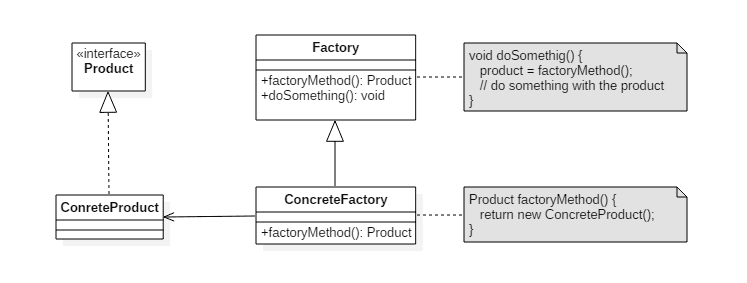
工厂方法
在简单工厂中,创建对象的是另一个类,而在工厂方法中,是由子类来创建对象。
定义一个创建对象的接口,但让子类决定实例化哪一个类。工厂方法使一个类的实例化延迟到其子类。
1
2
3
4
| public abstract class Factory {
abstract public Fruit getFruit();
}
|
1
2
3
4
5
6
7
| public class AppleFactory extends Factory{
@Override
public Fruit getFruit() {
return new Apple();
}
}
|
抽象工厂
提供一个创建一系列相关或相互依赖对象的接口,而无需指定它们具体的类。缺陷在于每添加一个新产品就要在抽象类进行修改,违反了开闭原则
1
2
| public class AbstractProductA {
}
|
1
2
| public class AbstractProductB {
}
|
1
2
| public class ProductA1 extends AbstractProductA {
}
|
1
2
| public class ProductA2 extends AbstractProductA {
}
|
1
2
| public class ProductB1 extends AbstractProductB {
}
|
1
2
| public class ProductB2 extends AbstractProductB {
}
|
1
2
3
4
| public abstract class AbstractFactory {
abstract AbstractProductA createProductA();
abstract AbstractProductB createProductB();
}
|
1
2
3
4
5
6
7
8
9
| public class ConcreteFactory1 extends AbstractFactory {
AbstractProductA createProductA() {
return new ProductA1();
}
AbstractProductB createProductB() {
return new ProductB1();
}
}
|
1
2
3
4
5
6
7
8
9
| public class ConcreteFactory2 extends AbstractFactory {
AbstractProductA createProductA() {
return new ProductA2();
}
AbstractProductB createProductB() {
return new ProductB2();
}
}
|
1
2
3
4
5
6
7
8
| public class Client {
public static void main(String[] args) {
AbstractFactory abstractFactory = new ConcreteFactory1();
AbstractProductA productA = abstractFactory.createProductA();
AbstractProductB productB = abstractFactory.createProductB();
}
}
|
Builder
封装一个对象的构造过程,并允许按步骤构造,单如果这个实体类的属性超过4个或以上的时候就推荐使用建造者模式创建对象
1
2
3
4
5
6
7
8
9
10
11
12
13
14
15
16
17
18
19
20
21
22
23
24
25
26
27
28
29
30
31
32
33
34
35
36
37
38
39
40
41
42
43
44
45
46
47
48
49
| public class Person {
String name;
int age;
String phone;
int sex;
private Person(String name, int age, String phone, int sex) {
this.name = name;
this.age = age;
this.phone = phone;
this.sex = sex;
}
public static Builder builder(){
return new Builder();
}
public static class Builder{
String name;
int age;
String phone;
int sex;
public Builder name(String name)
{
this.name = name;
return this;
}
public Builder age(int age)
{
this.age = age;
return this;
}
public Builder phone(String phone)
{
this.phone = phone;
return this;
}
public Builder sex(int sex)
{
this.sex = sex;
return this;
}
public Person build() {
return new Person(name, age, phone, sex);
}
}
}
|
原型
原型模式使用原型实例指定待创建对象的类型,并且通过复制这个原型来创建新的对象。也就是说,原型对象作为模板,通过克隆操作,来产生更多的对象,就像细胞的复制一样。